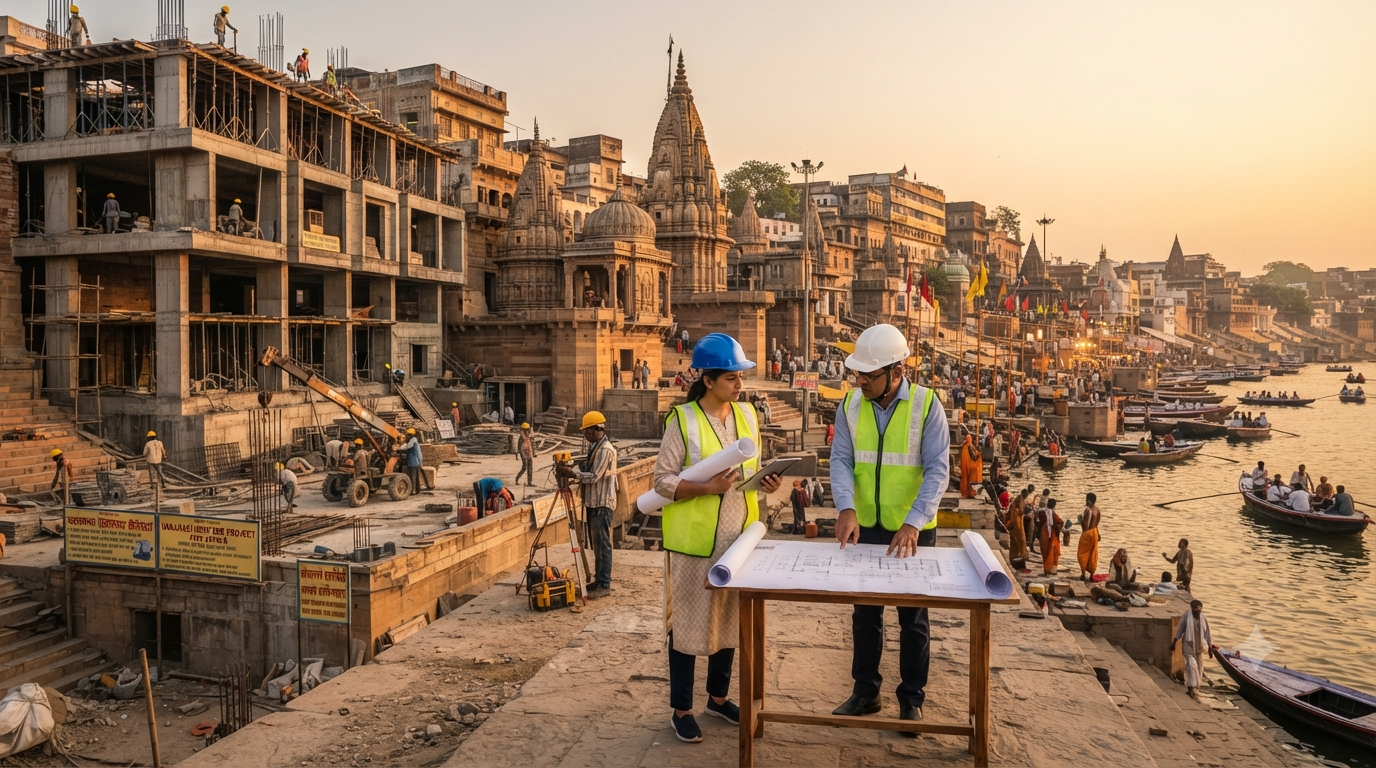
Building a home or commercial space in Varanasi is a big investment. The city has narrow lanes, old neighbourhoods, a high water table near the Ganga and heavy monsoon rains. A good construction company in Varanasi has to plan for all of these. This guide covers what to check before you sign a contract.
Why the Choice of Construction Company Matters
A wrong choice usually shows up as cost overruns, delays, cracks, seepage or disputes over payments. A right choice gives you a fixed scope, clear costs, quality material and a handover on time.
Many families in Varanasi build on small plots of 600 to 1,500 sq ft in dense areas such as Sigra, Lanka, Sarnath or Bhelupur. Material delivery, debris removal and neighbours’ walls all become real problems there. Your contractor must have handled such sites before.
1. Check Construction Experience
Years in business versus relevant experience
A company with 15 years of experience is not automatically the right one. Ask whether it has built the kind of project you want.
- Residential: independent houses, duplexes, apartments
- Commercial: shops, offices, small showrooms
- Local conditions: soil, drainage and flood-prone zones
Practical example
Suppose you plan a G+2 home on a 1,200 sq ft plot near the river belt. Ask the builder:
- What foundation type did you use on similar plots?
- Can I visit a completed site and talk to the owner?
- Which of your sites are under construction now?
A confident company will answer clearly and let you visit. A vague answer is a warning sign.
2. Look at Project Planning and Design Support
Good construction starts before the first brick is laid. A reliable building construction company in Varanasi should provide:
- Site inspection and soil assessment
- Floor plan and structural drawings
- Municipal approval guidance (Varanasi Development Authority, where applicable)
- A written work schedule by stage
What a stage-wise plan looks like
- Stage 1: Excavation and foundation
- Stage 2: Plinth and columns
- Stage 3: Slab and brickwork
- Stage 4: Plumbing and electrical conduit
- Stage 5: Plaster, flooring and finishing
If a company cannot show you this sequence on paper, expect confusion on site.
3. Verify Material Quality
Materials decide how long your building lasts. Insist on written specifications for the following.
Key materials to ask about
- Cement: brand and grade (OPC 43/53 or PPC)
- Steel: TMT bars with grade (Fe 500 or Fe 500D) and brand
- Bricks: type and strength
- Sand and aggregate: source and quality
- Plumbing and electrical items: brand and ISI marking
Practical example
If a quote says only “good quality steel”, ask for the brand and grade in writing. Two quotes can differ by ₹80–150 per sq ft because one uses branded TMT bars and the other uses unbranded material. Compare quotes on the same specifications.
4. Understand Cost Estimation
A transparent estimate has a detailed Bill of Quantities (BOQ), not just one lump-sum figure.
Ask these questions
- Is the rate per sq ft inclusive of materials (a “with material” contract) or labour only?
- What is excluded, such as boundary wall, water tank, septic tank or elevation work?
- How are changes during construction priced?
- What is the payment schedule?
Safe payment practice
Link payments to completed stages, not to calendar dates. Do not pay a large advance up front. Keep a 5–10% retention until final handover and snagging are complete.
5. Assess Labour Management
Construction quality depends heavily on workers. Ask whether the company:
- Uses its own trained crew or relies on subcontractors
- Has a site supervisor or engineer present daily
- Keeps skilled masons, bar benders, electricians and plumbers available
- Pays workers on time, since unpaid labour often leaves sites abandoned
A site with a regular supervisor and a stable team usually delivers better finishing and fewer disputes.
6. Confirm Safety Standards
Safety protects workers, your neighbours and your investment. On a reliable site you should see:
- Helmets, gloves and safety shoes in use
- Properly tied scaffolding and secure ladders
- Barricading and covered excavation near lanes
- Safe storage of cement, steel and electrical equipment
- Insurance cover for workers, where applicable
In Varanasi’s tight lanes, a poorly managed site can damage neighbouring property and lead to legal trouble for you as the owner.
7. Check Project Timelines
Ask for a start date, milestone dates and a handover date in writing. As a rough guide, a standard 1,200 sq ft ground-plus-one house often takes 8 to 12 months, depending on design, approvals and weather.
Examples of timeline risks
- Monsoon (June–September): slows excavation, concrete work and plastering
- Festival and wedding seasons: labour availability drops
- Late material orders: steel or tiles arrive after the slab is ready
Ask how the company handles delays, and whether the contract includes a clause for them.
8. Insist on Quality Checks
Quality checks should happen at set points, not only at the end.
- Before concrete pouring: reinforcement spacing, cover blocks, shuttering levels
- During concreting: slump test and proper curing
- After brickwork: plumb and alignment
- Before plaster: conduit and pipe pressure tests
- Before handover: waterproofing test, electrical load test, finishing inspection
Ask for a checklist and photos at each stage, which should be easy for any good company to provide.
Comparison: Reliable Company vs. Risky Company
| Factor | Reliable Construction Company | Risky Construction Company |
| Experience | Shows completed local projects and allows site visits | Gives only verbal claims and avoids visits |
| Planning | Provides drawings, stage-wise schedule and approval guidance | Starts work without a written plan |
| Materials | Names brands and grades in the agreement | Uses vague terms like “good quality” |
| Cost estimate | Detailed BOQ with inclusions and exclusions | One lump-sum figure with hidden extras |
| Labour | Trained crew with a daily site supervisor | Changing workers, no supervision |
| Safety | Safety gear, scaffolding checks, barricading | Little or no safety practice |
| Timeline | Written milestones and delay clauses | “It will be done soon” |
| Quality checks | Stage-wise inspections with records | Inspection only at the end, if at all |
| Payments | Linked to completed stages | Large advances demanded early |
Residential Construction Services: What to Expect
For homes, a good company should handle residential construction services from design to finishing, whether you need a single-storey house, a duplex or a multi-floor family home. When you check Syncsho’s list of construction services, confirm the exact offerings [confirm on Syncsho: e.g. the residential and house construction services listed on the site] and ask what is included in each package.
How Syncsho Can Help
Syncsho helps you compare construction options in one place so you can ask better questions before committing. Before you shortlist, review the construction services in Varanasi that are verified on Syncsho [confirm on Syncsho and list only the services shown on the site]. Then check each one against the factors above.
A Simple Checklist Before You Sign
- Visit at least two completed projects
- Get written specifications for materials
- Compare at least three detailed quotes
- Confirm the payment schedule is stage-based
- Ask for the timeline with milestone dates
- Check that safety practices are in place
- Make sure drawings and approvals are in order
- Read the contract fully, including the delay and defect clauses
Frequently Asked Questions
Examine the completed projects, request for references, go through the written agreement and see if the contractor provides a site supervisor and stage-wise inspections.
Prices vary according to design, material and degree of finishing. You can’t just look at price per sq-ft. Detailed BOQ request. Get quotes from a number of companies.
A “with material” contract is easier to deal with but you have to check material specs. A labour only contract gives you control of what you buy, but you have to manage buying and wastage.
The typical independent house will take from 8 to 12 months to build depending on its size, approvals, weather and design changes.
Pay as work is done, i.e. foundation, slab, finishing. Keep a little retention until hand over; don’t make big advances
Yeap. Approved drawings reduce legal risk and prevent mid-way changes. A good company will take you through the approval process.
Water-proofing. Check plumbing points. Electrical points. Flooring. Doors and windows. Paint finish “Prepare snag list and get defects fixed before final payment is released.
Conclusion
The right construction company has a proven experience, a clear plan, specified materials, transparent costs, a managed workforce, safe practices, realistic timelines and regular quality checks. Get three options, get everything in writing and check out completed sites before you choose. Browse verified construction services on Syncsho and shortlist the companies which suits your requirements.